Tag: Bordeaux

The view from Bordeaux – Lafite’s first tranche

Yesterday saw the release of the first tranche of Château Lafite-Rothschild en primeur. It was a surprising move, hinted at late last week, but early for a first growth to release in what is set to be a long campaign. People were momentarily excited – the campaign seemed to be taking off, with a seemingly reasonable price for a first growth that has historically gained in price after release. However, it very quickly became clear that with just half last year’s volume released, and the promise of a second tranche at a higher price, Bordeaux négociants preferred to hold fire and wait it out.

One courtier said, “to my mind it is not a real release of Château Lafite 2016 because [the price of] a part of the volume en primeur is not known.”

The tranche system for Bordeaux en primeur releases was born of two rationales. First, a way of testing the market with an initial, reasonable price on a portion of the volume produced. Second, tranches are a politically adept method for the five Bordeaux first growths to maintain the appearance of releasing at the same price – as has historically been the form – with the possibility thereafter to diverge significantly in price on subsequent tranches.

There are several négociants whose policy is to adhere to the châteaux’s multi-tranche approach, selling on the first at a corresponding price, and the second at a higher price, and so on. However, those négociants had second thoughts yesterday. If they sell the first tranche at the lower price while other négociants await the second tranche and sell at an average price across the two tranches, they will be stuck with a second batch of wine to sell at a higher price than the rest of the market.

That is why the vast majority of négociants yesterday decided not to sell on their Lafite 2016. One négociant explained that the “volume makes it difficult to offer out,” adding “we’re just waiting for the second tranche to offer in one bunch, at an average price.”

So as the entire Place de Bordeaux waits for the second tranche, after which it will sell on the stock at a pro rata price taking into account the price of both tranches, this begs the question: what was the point of separate tranches at all? Had today’s release been on a larger volume, it could have been the touch paper for a sizzling 2016 en primeur campaign. At 50%, unfortunately, it has proved the opposite.

Reports from the Place are that after the Lafite release early yesterday afternoon, not only were there no further releases, but sales on all other wines slowed right down as the local market let Lafite’s move sink in. Not surprising when you consider the importance for a négociant of a first growth’s release in the scheme of an en primeur campaign: it represents a huge sum compared to selling the lesser crus. If yesterday’s events put other châteaux off releasing today, then with the Thursday bank holiday in France, and many bridging to a long weekend, “a whole week of the campaign could be lost,” lamented another négociant (although this is unlikely with another major wine set to release this morning).

Meanwhile, many importers are frustrated by their inability to actually acquire any of the wine and offer it to their customers. One UK merchant concurred, “it’s not a real release,” clarifying, “until the Bordeaux négociants know what their total volumes are – and what their average cost will be – they can’t really offer the wine to the trade so customers are unable to buy it.”

And so we all await the second tranche. One courtier has been led to believe this will be next week, while Château Lafite itself declines to advise on timing.
Mouton and Petrus top list of Bordeaux crus

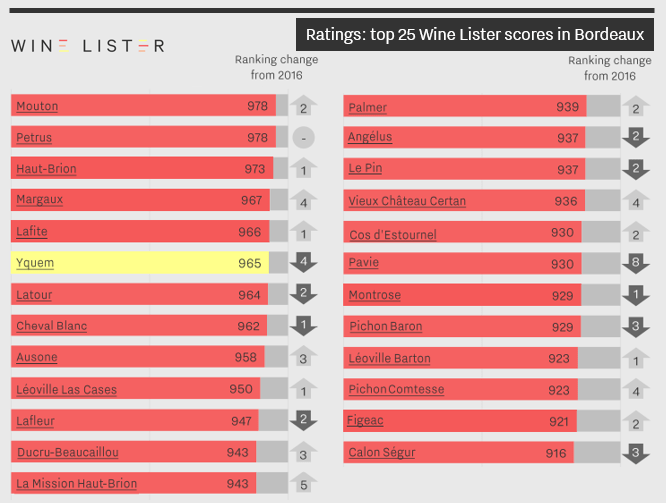
In our third blog post exploring findings from Wine Lister’s recently released Bordeaux Market Study, we look at the top scoring Bordeaux crus as at 28th April 2017. These are the overall Wine Lister scores comprising the three category scores for Quality, Brand, and Economics. They are applied at wine level (an average of the last 30 vintages, with the highest weighting for the most recent vintage – 2016 – and so on).

Top Wine Lister scores Bordeaux

Nine of the top 25 are from the right bank, and 16 from the left bank. As in last year’s study, the top eight spots are occupied by the five left bank first growths, as well as Petrus, Yquem, and Cheval Blanc, but with a significant reshuffle among these wines. Mouton gains 18 points and climbs two spots to join Petrus at the top of the table this year.

Haut-Brion comes third, one position higher than in 2016. Next come Margaux and Lafite, separated by just one point, although Margaux has surged up the ranking this year, gaining four places.

Yquem, the only white wine in the top 25, drops four places this year, while Latour and Cheval Blanc are also down on last year’s positioning. Ausone comes ninth, up three places from last year, and Léoville Las Cases rounds out the top 10 as the highest placed deuxième cru.

The two newer Saint-Emilion premiers grands crus classés A also feature in the top 25, although Angélus and Pavie have dropped two and eight spots respectively since 2016. Meanwhile Pichon Comtesse and Figeac make their debut into the top 25 this year.

This is just a taster of the Bordeaux Market Study, but you can download the full 48-page report from the Wine Lister Analysis page (subscribers only).

Bordeaux 2016: arriving at a release price

In today’s blog we continue to explore some of the findings from our new in-depth study on Bordeaux, available for subscribers here. Having looked at the wines in which the trade has most confidence, we now turn our attention to Bordeaux 2016, and a key question: how might a château arrive at an appropriate en primeur release price?

Using average figures for 79 of the top Bordeaux crus, we explore two approaches. First, simplistically, we look at release prices of previous vintages, and apply the trade’s suggested decrease of 4% (see here for more) to the average 2015 release price. This is represented by the dotted line.

However, Wine Lister Founding Members were canvassed before having tasted the 2016 vintage, now considered to be excellent, and so the average suggested decrease of 4% on 2015 prices seems unrealistically low. Some châteaux have already released maintaining their 2015 price, which has been well received by the trade, while others have applied increases in euro terms, which in turn are amplified by the current exchange rate when converted into UK offer prices.

For each wine, it is also necessary to take into account the reception by the market of last year’s price, as well as this year’s relative quality.

Bordeaux 2016 arriving at release price

The second, more sophisticated approach, involves comparing the average Quality scores from the last eight vintages to the current market price for those vintages.

The closest quality rating to 2016 is 2015, but as this vintage is not yet delivered, the most appropriate vintage for comparison is 2010. As such, we have applied the quality to price ratio from 2010, in order to arrive at a derived future market price for the 2016 vintage on average, according to its current quality assessment.

The average price per bottle could be expected to reach €161 in the marketplace in due course.

Margins taken by the négociant and then importers tend to amount to around 25-30%, although this varies from wine to wine.

That would take us to around €117 per bottle at release. Then we apply a 10%-20% “discount” to the consumer for buying en primeur, before they receive the physical product. This suggests an average ex-château release price of €93 to €105 (see chart).

In general, this would mean that 2016s should be priced below current market prices for 2015, and well below 2010 market prices.

For further detail, or to enquire about price analysis on specific châteaux, please email team@wine-lister.com.

Trade’s confidence in Bordeaux grows

In last year’s inaugural Bordeaux study, Wine Lister recapped the region’s recent turbulence and concluded that Bordeaux was moving into a more positive phase. This year’s study – published this week, and available for subscribers here in English and French – continues that analysis, examining the region’s global positioning in the market before drilling down into its appellations and more than 100 of its top wines.

We’ll be revealing a few of the report’s findings over the coming weeks, beginning here with the trade’s view. Earlier in the year we surveyed our Founding Members (49 key fine wine trade players from across the globe), for insight into their confidence in Bordeaux’s individual wines. None got a perfect 10/10, but eight received 9/10, compared to only three last year (Latour, Margaux and Petrus), highlighting the trade’s surging confidence over the last 12 months:

Bordeaux_trade's view_confidence_9

While the majority of wines moved up one place from an 8/10 rating last year, Canon has greatly improved its position within the trade, leaping ahead three points from 6/10. Its 2015 vintage was declared by many to be the estate’s best: our US partner critic Antonio Galloni called it “one of the undisputed stars of the vintage” and awarded it an in-barrel score of 96-98/100. Canon 2016 has also been lauded by the critics, scoring 18.5/20 from our UK partner critic Jancis Robinson.

Bordeaux_trade's view_confidence_8

Meanwhile, 21% of the 108 wines surveyed received a confidence rating of 8/10, up from 18% of wines last year. Those whose standing has leapt significantly include Domaine de Chevalier, Haut-Bailly, Petit Mouton, Smith Haut Lafitte and Talbot, all up from 6/10 last year.

Visit Wine Lister’s Analysis page to read the full 48-page report, ‘2017 Bordeaux Market Study – A true return to form?’, available in both English and French.

Bordeaux 2016 top wines by Quality score

Now that all our partner critics’ scores have been published, we have been able to feed them into Wine Lister’s bespoke algorithm to arrive at Quality scores for the Bordeaux 2016 vintage. The top 15 wines are shown below.

Wine Lister’s Quality score combines the ratings from our partner critics, three of the most respected critics in the world – Jancis Robinson, Antonio Galloni, and Bettane+Desseauve. A small weighting is also added for a wine’s ageing potential.

2016 Top Quality Scores 2

Ironically, the top wine of the vintage is Latour, not available to buy en primeur since the château withdrew from the system in 2012. The Pauillac first growth surged 34 positions up the table from last year, to 992 points for its 2016 Quality score.

Lafleur is just behind on 990, closely followed by Haut-Brion, Petrus and Vieux Château Certan. In fact, all the usual contenders make an appearance in the top 15, including the five first growths, their right bank equivalents such as Le Pin, Cheval Blanc, and Ausone, and Sauternes’ own first growth, Château d’Yquem.

Less obvious showings that are likely to represent better value include Calon Ségur, which improved a mammoth 51 places on last year, as well as Figeac and Pontet-Canet, in joint 15th position.

The top 40 2016 Quality scores will be listed in our upcoming Bordeaux market study, due for release later this week, and available to subscribers here. Alternatively, see the full ranking on the website.

Bettane+Desseauve’s top Bordeaux 2016 scores

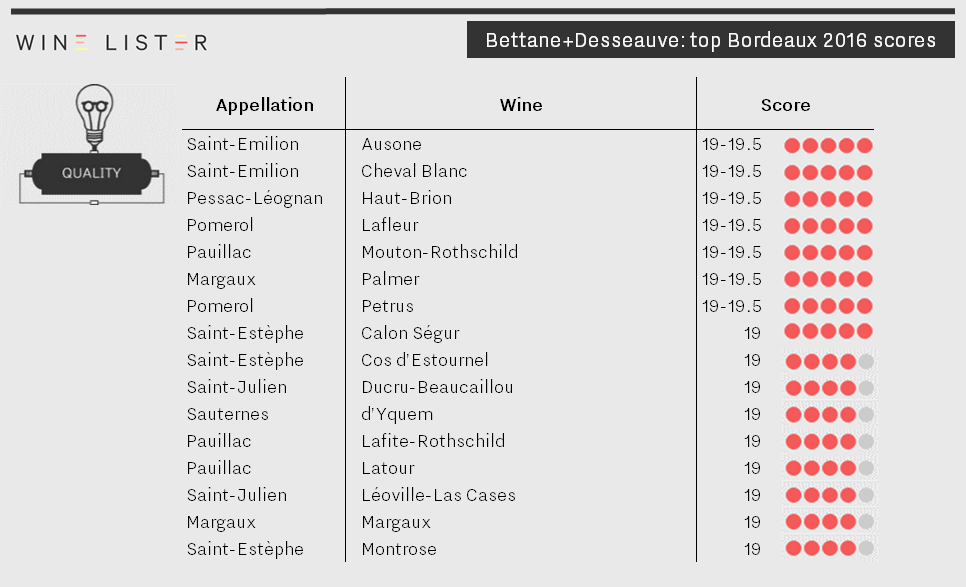
Wine Lister’s French partner critics, Bettane+Desseauve, released their Bordeaux 2016 en primeur scores today. Here is a first look at thier top-scoring wines:

B+D top Bordeaux 2016 scores

Bettane+Desseauve awarded no potentially-perfect scores, but seven wines score 19-19.5 points. One is Château Ausone, which receives this rave review:

“Refinement of texture and fullness of body. An Ausone of immense depth, broader shouldered than usual but with the same majestic, finessed tannins. A giant.”

As for fellow Saint-Emilion premier grand cru classé A Cheval Blanc, Michel Bettane calls it “the greatest wine from the property, at least as a baby, for at least 20 years!”

All the left bank first growths score 19 or above, as do Petrus and Yquem. Otherwise the top scorers shown above are all first growth equivalents or second growths, apart from Calon-Ségur, a third growth which made a standout wine in 2016.

These scores complete Wine Lister’s partner critic triptych, allowing us to compute Quality scores for the Bordeaux 2016 wines. More detailed analysis will be published next week in this year’s Bordeaux study, which will be available to subscribers here.

Antonio Galloni’s top Bordeaux 2016 scores

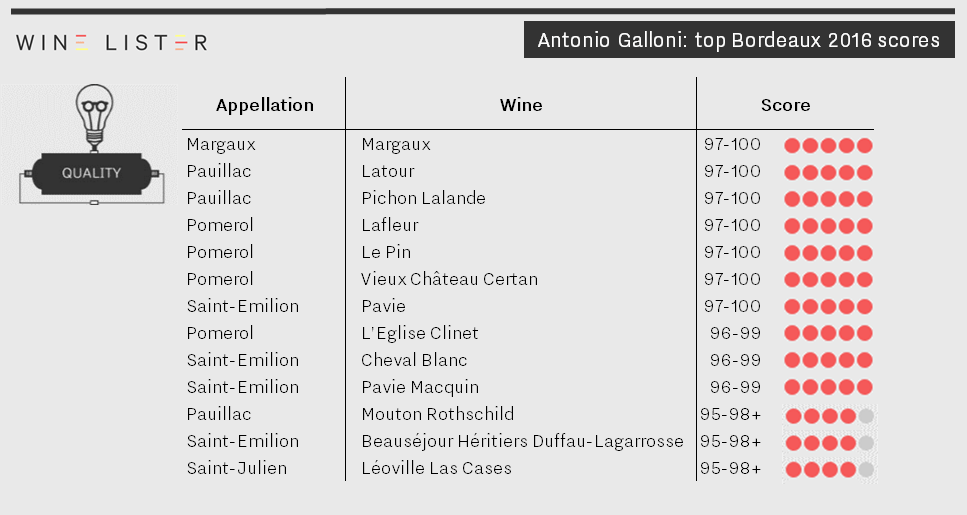
Wine Lister’s US partner critic Antonio Galloni, of Vinous, released his scores for Bordeaux 2016 en primeur in a comprehensive article at the end of last week, and these now contribute to Wine Lister’s Quality scores for Bordeaux 2016 wines.

Galloni describes the vintage as one of balance and harmony, yielding “absolutely remarkable wines.” He awarded seven potential 100-pointers, including two first growths – Châteaux Margaux and Latour, as well as three top Pomerol wines – Lafleur, Le Pin, and Vieux Château Certan.

He was particularly impressed by Château Pichon Longueville Comtesse de Lalande, which he found “a deeply emotional, moving wine.” He also had his head turned by Saint-Emilion premier grand cru classé A, Château Pavie, which has shifted towards a more elegant style since 2014, and particularly this year, when Galloni calls it “seamless, sumptuous and super-expressive.”

ag

After waxing lyrical about many of the wines from the 2016 vintage, Galloni turns his attention to the campaign, and to pricing, echoing the positive signs discussed in our recent blog post on this topic. Galloni concludes that given the quality of the vintage, “if the 2016s do not sell well, it will be a damning indictment that one or more things is seriously wrong with how the wines are sold.”

Galloni also appeared on Bloomberg TV to discuss whether 2016 is the Bordeaux vintage of the century. Watch his interview here.

Jancis Robinson’s top Bordeaux 2016 scores

Wine Lister’s UK partner critic Jancis Robinson has released her scores for Bordeaux 2016 over a series of tasting articles, and these can now be found on Wine Lister’s individual wine pages.

While 2016 has been hailed by some as a left bank vintage, Robinson found much to enjoy across both sides of the Gironde. In Pomerol, she praised “those who waited and managed the difficult business of judging picking times correctly”, and more 19-point wines came from this appellation than any other. She singled out Vieux Château Certan 2016 for setting “the standard for the appellation” and noted its “lovely ripeness and nobility.” In Saint-Emilion, 19-point Figeac 2016 was “Zesty and confident and of the place”, while Canon 2016 had “real lift and drive.”

jr

On the left bank, three of the first growths were among Robinson’s top scorers. As Wine Lister has already noted, 2016 was a tricky growing season, and Robinson reports that at Haut-Brion, Jean-Philippe Delmas “pointed out that the vintage was saved by the cool nights that retained the grapes’ and therefore wines’ freshness.”

From Pauillac, Latour 2016 significantly had “much more finesse than traditional Latour”, while Robinson described Mouton Rothschild 2016 as “bone dry and utterly embryonic compared with most of the 2016s (with the notable exception of Las Cases).” Léoville Las Cases 2016 also received 19 points from Robinson.

Notably, amongst Robinson’s top scorers there are no dry whites – a category she described as “the least exciting section of the Bordeaux 2016 vintage” – and only one sweet white (Yquem 2016), a group for which Bordeaux 2016 “won’t go down in history.”

Trading volumes on the rise in Q1 2017

Trading volumes are a key measure of a wine’s success in the marketplace. To evaluate these, Wine Lister uses figures collated by Wine Market Journal from sales at the world’s major auction houses, looking at the total number of bottles sold of the top five vintages traded for each wine over the past four quarters.

With the first quarter data now in, we look at which wines saw the greatest incremental increase in bottles traded. Although the list is dominated by French wines, top of the table is a Tuscan, Biondi Santi Brunello di Montalcino Riserva. The producer was recently highlighted as one to watch in a survey of Wine Lister’s Founding Members. The rise in auction sales for this wine has had a significant impact on its Economics score, boosting it from 911 to 945/1000. Volume is just one of the five criteria that feed into a wine’s Economics score, along with four different price-related metrics.

Wine Lister Volume Changes April

The wine seeing the second largest gain in trading volumes, Domaine du Pegau Châteauneuf-du-Pape Cuvée Réservée, also has the lowest Economics score of the table, at 789. Nonetheless, its overall Wine Lister score is very strong at 846 (lifted by a high score for Brand), and with the latest data in from Wine Market Journal its Economics score is on the rise.

The final three wines of the table – two Bordeaux first growths and a prestigious Champagne (Taittinger Comtes de Champagne)  – also benefitted from increased trades in the last quarter. All three enjoy very high Economics scores, with Lafite Rothschild the highest, at 955/1000. Meanwhile it seems that 2017 has been a positive year so far for Latour, which was also among the top five wines that saw its number of searches increase significantly in March.

Will earlybird Cos d’Estournel catch the worm?

Château Cos d’Estournel took everyone by surprise this morning when it released its 2016 vintage en primeur sooner than expected, at €120 per bottle ex-négociant, the same price as its 2015. Intelligence gathered by Wine Lister suggested that châteaux considered to have made “mistakes” with the release of their 2015 vintage en primeur might release early and at the same price as last year.

However, even the Place de Bordeaux was not expecting a second growth to release its wine the day after the first round of the French presidential elections, and just four days after the terrorist attack in Paris.

Cos d’Estournel is considered to have had a mediocre 2015 en primeur campaign compared to some of its peers, not necessarily pricing too high, but releasing too early. However, reports are that stocks did sell through later in year. Today’s move is bold, but could pay off, if Cos d’Estournel 2016 can harness the excitement that is growing around the Bordeaux 2016 vintage before it has too much competition.

cos2

© Château Cos d’Estournel

By sticking to last year’s price, Cos is keeping the Bordeaux trade happy, and early reports are that négociants are wholeheartedly getting behind the release. The weak pound means that Cos d’Estournel 2016 is being offered to consumers in the UK at £117 per bottle, a 10% premium on the 2015 price of £106 per bottle. This might well be palatable given the quality of the wine this year and the goodwill shown by the château in not increasing its euro release price. UK merchants certainly seem to be enthusiastic in terms of their messages to consumers so far.

Wine Lister’s UK partner critic Jancis Robinson awarded the Cos d’Estournel 2016 18 points (compared to 18.5 for the 2015). Our French partner critics Bettane+Desseauve, and our US partner critic, Vinous, will release their Bordeaux 2016 scores later this week.