Tag: California

California: production versus price

This week’s listed section looks at the five most expensive Californian wines. Unsurprisingly, the list comprises five cult Napa reds, all with small annual productions helping to fuel a healthy supply and demand ratio that keeps consumers thirsty and wanting more.

Top 5 Californian most expensive image

Leading the way is Screaming Eagle, averaging c.7,800 bottles per year. At £2,450 per bottle, it is the 12th most expensive wine in Wine Lister’s database, just £27 below DRC La Tâche.

Harlan, the third highest-rated Californian wine overall, has an average annual production of c.21,600 bottles, and is the region’s second most expensive wine. At £638, it is available at nearly a quarter of the price of Screaming Eagle.

The next three wines all have lower production volumes than Harlan. At £509, Scarecrow has a similar price point to the likes of Lafite (£522) and Masseto (£524). Fourth-placed Grace Family Vineyards Cabernet Sauvignon achieves a Wine Lister score of 712, considerably lower than the others, but again low production volumes (c.6,000 bottles a year) help it to achieve its hefty price tag of £474. Bryant Family Vineyard Cabernet Sauvignon fills the fifth spot at £460 per bottle.

Produced on far greater scales than these five, Dominus and Ridge Monte Bello, Wine Lister’s two overall top-scoring Californian wines, do not make the top five most expensive. The trendline on the chart below confirms the negative correlation between price and production:

Californian production vs price image

Remember that even if you don’t currently have a Wine Lister subscription you can access all the underlying data behind these five wines as well as those featured in other Top 5s, giving you an insight into the wealth of tools at our subscribers’ disposal.

Price vs brand: getting brand for your buck

Following on from our recent blog on the relationship between price and quality for seven leading wine regions, today we turn our attention to the role that brand strength plays on price for those same regions. The chart below compares the regions’ average three-month market price to their average Brand scores, using the same 50 overall top scoring wines in each region as in the previous post.

Price per bottle vs Brand score

Bordeaux’s crus classés enjoy unassailable brand strength, a product of the success of the region’s classification system and the fact that its châteaux have enjoyed global renown for centuries. If you want brand for your buck, look no further.

Conversely, Burgundy’s extraordinary prices far exceed the level of brand clout commanded by its top crus. Its top wines trail the average Brand score of Bordeaux’s by 7%, but sell for nearly six times as much. This suggests that quality, and perhaps small production levels, play more of a part in the region’s prices.

The five remaining regions are more evenly matched. Tuscany’s wines have both the lowest average Brand score and the lowest prices, followed closely by Piedmont. Meanwhile California’s top 50 wines, which have the second-lowest average Brand score, command the second-highest prices. Top wines from the Rhône and Champagne command similar prices to their Bordeaux counterparts, but with average Brand scores more than 100 points lower.

Price vs quality: getting more for your money

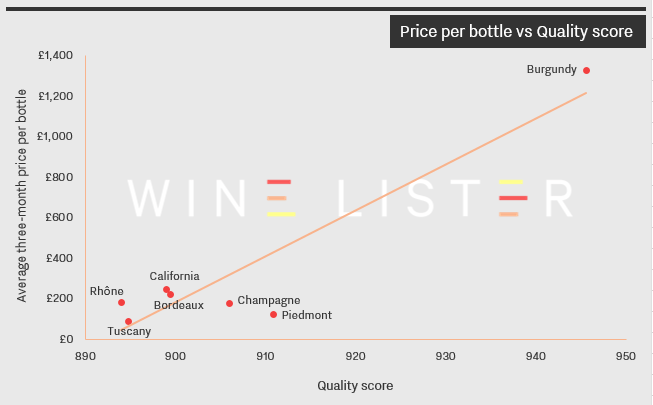
In today’s blog, we’ve taken a look at the relationship between price and quality for seven leading wine regions. The chart below compares the regions’ average three-month market prices to their Quality scores, with the data calculated from each region’s 50 best-scoring wines (in terms of overall Wine Lister score).

Price per bottle vs Quality score

While six regions are clustered relatively close to each other, Burgundy finds itself at the extreme top end of the scale: its wines outperform on quality and have the prices to match. The top 50-scoring wines in Burgundy average a whopping £1,330 per bottle, driven by the likes of DRC La Romanée-Conti at £10,776 and Domaine Leroy Musigny at £7,805.

The Rhône’s wines have the lowest average Quality score but not the lowest prices: at £188 per bottle on average, they are the fourth most expensive of the group. California and Bordeaux display a very similar profile, appearing just above the trendline, indicating that these wines command high prices not simply on account of quality – brand also plays a part.

Champagne and Piedmont, meanwhile, fall below the line, suggesting that as regions they tend to offer value for money. Piedmont’s ranking is particularly impressive: second only to Burgundy in terms of average Quality score, its wines are available for a tenth of the price on average.

Tuscany: a global contender

Wine Lister has produced its second in-depth regional study, this time on Tuscany – a many-faceted fine wine region that is fast-building its position on the global fine wine stage. We will be revealing some of the findings on the blog in the next few weeks, but the full 35-page report is available for subscribers on the Analysis page.

The study focuses on 50 top Tuscan wines, which we have compared below with 50 wines from Piedmont, Bordeaux, Burgundy, and California. Using the three categories that comprise an overall Wine Lister score – Quality, Brand, and Economics – we can put the region’s global positioning in context.

Tuscany Wine Lister Report - regional scores

Although Tuscany comes fourth overall – just ahead of Piedmont – its Quality score is bettered only by Burgundy, scoring 883 points to Burgundy’s 917. Quality scores are derived from Wine Lister’s partner critics’ scores and a wine’s ageing potential, and Tuscany’s excellence in this category may be one explanation for its rising appeal.

Tuscany’s Brand score is the fourth best of the group, suggesting that after a handful of top brands such as the Super Tuscans, the rest of the top 50 do not confer the same level of prestige as wines in Bordeaux, Burgundy, or even California. Meanwhile, the region’s commercial clout is the weakest of the group, scoring one point less than Piedmont in the Economics category.

In upcoming posts, we will delve into the trade’s view on Tuscany’s foremost appellations and which are the wines to watch.