Tag: Quality Score

Listed: five new wines to explore each week

You may have noticed a subtle re-design today on the Wine Lister homepage. This includes moving up and expanding the scope of the “Listed” section: a changing Top 5 of wines from around the world, updated each week.

You can now explore the five most recent Top 5s, even if you’re not yet a subscriber to Wine Lister. For as long as the list is live, this includes access to all the underlying vintage-level data that feeds into one of our Listed wines, including critic scores, restaurant presence, search frequency, and price performance. Simply click on the Listed wine that takes your interest, then select from the drop-down of vintages at the top right of the wine page. What’s more, this allows you to play with tools such as interactive price history and vintage value identifier charts.
Listed_Top Tuscan wines

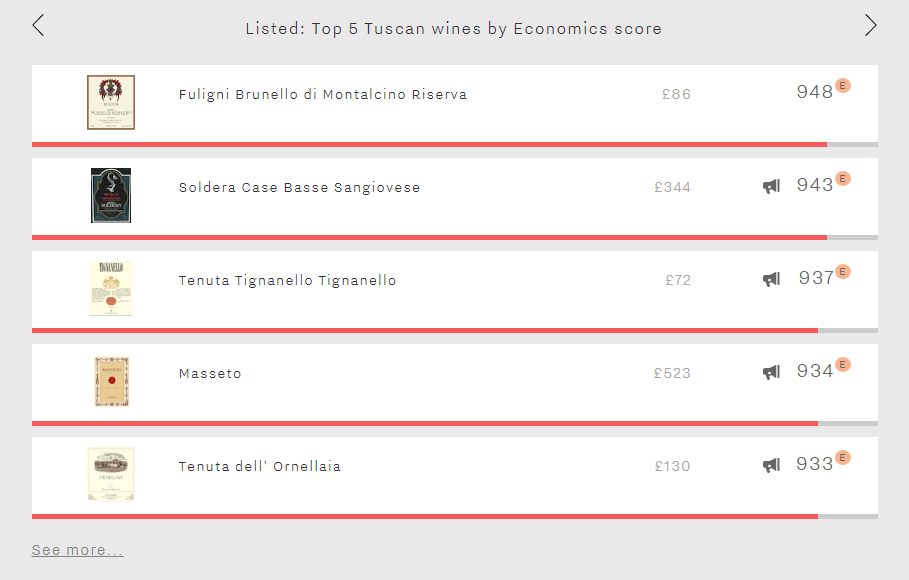
Our Listed section addresses a variety of tastes and priorities – some weeks you will see our best Value Picks from a particular region, other weeks will focus specifically on wines with top Brand or Economics scores, or wines of the highest quality from a specific vintage.

To access independent wine ratings, tools, and analysis for all of the thousands of wines and vintages in our database you’ll need to subscribe – or why not try a free 14-day trial?

Latest search data: basketball beats Bordeaux

The latest online search frequency data is in from Wine-Searcher, and with it we can see which wines surged in popularity during June. As with May’s results, the effect of the 2016 en primeur campaign is evident, with four of the five spots filled by Bordeaux crus that released their 2016 vintage on or after 31st May.

June Search Frequency image v2

However, if the en primeur effect is to be expected, the likely reason for Giuseppe Quintarelli Alzero’s appearance at the top of the table could not have been foreseen. On 18th June, NBA star LeBron James posted a photo on Instagram of a bottle of Giuseppe Quintarelli Alzero 2007 that he was enjoying, having spent the day hosting his son’s birthday party. To date it has received well over 200,000 likes, surely contributing to its 168% increase in online search frequency. It appears that whilst La Place de Bordeaux is the fine wine world’s premier marketing machine, it is no match for LeBron James and his 31.8 million Instagram followers.

Returning to the en primeur effect, Canon 2016 was released at £73.35 per bottle on 1st June to great acclaim, having achieved its second-best Quality score ever. The leap in search frequency confirms its upward trajectory. Figeac repeats its May performance, surging even further in popularity in June. The 2016 vintage – Figeac’s best since 1989 – was released on 13th June, its 67% increase on the 2015 sterling release price signalling its clear intent to reposition itself.

Calon Ségur and Les Carmes Haut-Brion both comfortably achieved their best ever Quality scores with their 2016 offerings, and sold out quickly, no doubt prompting their surges in online search frequency during June. The next step is to get a famous sportsperson to post a photo of themselves drinking it.

Price vs quality: getting more for your money

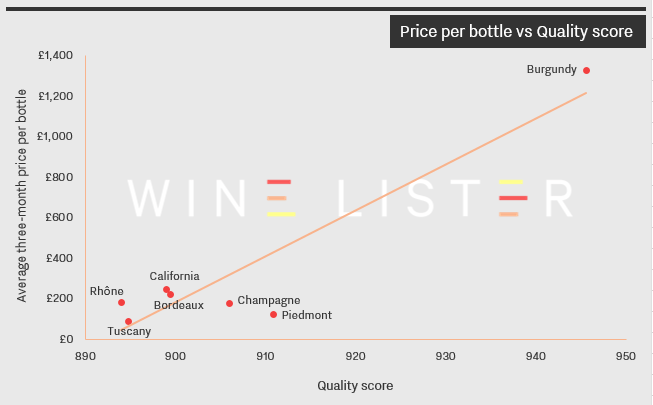
In today’s blog, we’ve taken a look at the relationship between price and quality for seven leading wine regions. The chart below compares the regions’ average three-month market prices to their Quality scores, with the data calculated from each region’s 50 best-scoring wines (in terms of overall Wine Lister score).

Price per bottle vs Quality score

While six regions are clustered relatively close to each other, Burgundy finds itself at the extreme top end of the scale: its wines outperform on quality and have the prices to match. The top 50-scoring wines in Burgundy average a whopping £1,330 per bottle, driven by the likes of DRC La Romanée-Conti at £10,776 and Domaine Leroy Musigny at £7,805.

The Rhône’s wines have the lowest average Quality score but not the lowest prices: at £188 per bottle on average, they are the fourth most expensive of the group. California and Bordeaux display a very similar profile, appearing just above the trendline, indicating that these wines command high prices not simply on account of quality – brand also plays a part.

Champagne and Piedmont, meanwhile, fall below the line, suggesting that as regions they tend to offer value for money. Piedmont’s ranking is particularly impressive: second only to Burgundy in terms of average Quality score, its wines are available for a tenth of the price on average.

Bordeaux 2016: value for money

A couple of months ago we looked at which Bordeaux 2016s received the best Quality scores, calculated from scores given by our three renowned partner critics: Jancis Robinson, Antonio Galloni, and Bettane+Desseauve. Such quality comes with a price, however, and if the £430 per bottle for Lafleur (Quality score 990) is a little beyond your price range, then we hope this blog is useful. Below are the nine wines from the vintage which qualify as Wine Lister Value Picks.

None of the Value Picks was among the top 15 in our previous blog. Nevertheless, they all enjoy strong or very strong Quality scores on the Wine Lister scale. Fombrauge scores 898, and was described as “rather opulent” and “very successful” by Jancis Robinson. Available at just £16 per bottle, it represents excellent value for money.

Even the wine with the highest Quality score, sweet white Doisy-Daëne (899), is only £25. Those wishing to spend slightly less on a sweet white might also consider Filhot, which achieves a Quality score of 709, and is available at just £14 per bottle.

Bordeaux 2016 Value Picks

Please see our previous blog for further information on Wine Lister’s Value Picks.

France dominates latest Value Picks

Like Buzz Brands, which we explored last week, Value Picks are one of the four Wine Lister indicators, designed to highlight particularly interesting wines for our subscribers by isolating sub-sets of data. The Value Pick indicator helpfully identifies the wines and vintages which have the best quality to price ratio (with a proprietary weighting giving more importance to quality, thus allowing the finest wines a look-in).

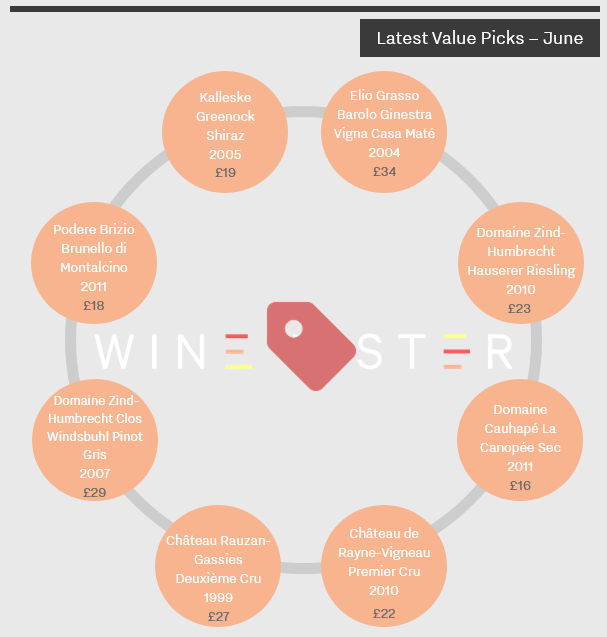
This month, five of our eight new Value Picks are from France – but with a Sauternes, Riesling and left bank Bordeaux to choose from the options are still diverse.  Most affordable is Domaine Cauhapé La Canopée Sec 2011, from Jurançon, at just £16 per bottle and with a Quality score of 733.

The most expensive wine – but still at only £34 per bottle – is one of the two Italians that feature this month: Elio Grasso Barolo Ginestra Vigna Casa Maté 2004, which has an exceptional Quality score of 971. The other wine in the table with a Quality score above 900 is Domaine Zind-Humbrecht Clos Windsbuhl Pinot Gris 2007, from Alsace, priced at under £30 and with a Quality score of 906.

June Value Picks

Please see our previous Value Pick blog for a note on prices.

The perfect wine

What makes the perfect wine?

Using the entirety of a 1,000-point scale, Wine Lister’s scores are calculated using nine criteria that define iconic wines. These fall into the categories of Quality, Brand and Economics, giving a 360° view of the finest wines in the world.

Unlike wine critics’ scores, which sporadically feature a perfect 100/100, a perfect Wine Lister score of 1,000/1,000 is practically, though not theoretically, impossible. The perfect wine would have to be the best in the world across every single criterion – a magical combination of ingredients.

The perfect wine does not belong to any one region. In terms of quality, it has the perfect critic score of Sauterne’s unsurpassed Château d’Yquem (1), and the ageing potential of Cockburn’s Vintage Port (2). Its brand is legendary: like Dom Pérignon, it is found throughout the world’s top restaurants (3), and its online monthly searches rival those of Lafite (4).

The perfect wine outperforms on price. Already with a price per bottle to match that of Romanée-Conti (5), its vintages see price increases in both the short- (6) and long-term (7), without undue fluctuation (8). Finally, like Mouton, the perfect wine is traded in large volumes (9).

The perfect wine_Wine Lister

Download a PDF version here.

First published in French in En Magnum

Mouton and Petrus top list of Bordeaux crus

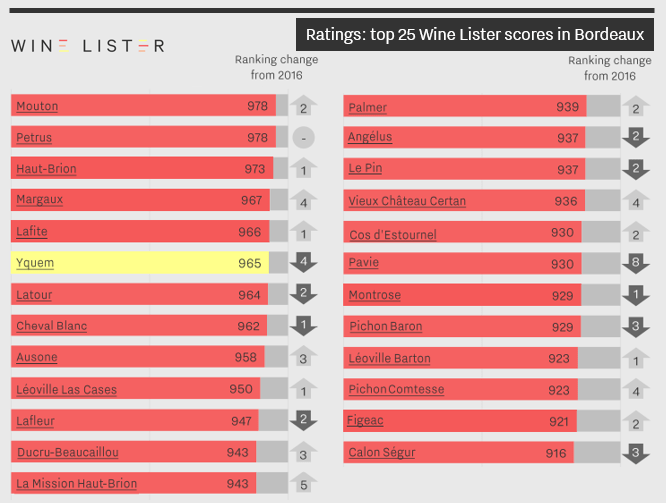
In our third blog post exploring findings from Wine Lister’s recently released Bordeaux Market Study, we look at the top scoring Bordeaux crus as at 28th April 2017. These are the overall Wine Lister scores comprising the three category scores for Quality, Brand, and Economics. They are applied at wine level (an average of the last 30 vintages, with the highest weighting for the most recent vintage – 2016 – and so on).

Top Wine Lister scores Bordeaux

Nine of the top 25 are from the right bank, and 16 from the left bank. As in last year’s study, the top eight spots are occupied by the five left bank first growths, as well as Petrus, Yquem, and Cheval Blanc, but with a significant reshuffle among these wines. Mouton gains 18 points and climbs two spots to join Petrus at the top of the table this year.

Haut-Brion comes third, one position higher than in 2016. Next come Margaux and Lafite, separated by just one point, although Margaux has surged up the ranking this year, gaining four places.

Yquem, the only white wine in the top 25, drops four places this year, while Latour and Cheval Blanc are also down on last year’s positioning. Ausone comes ninth, up three places from last year, and Léoville Las Cases rounds out the top 10 as the highest placed deuxième cru.

The two newer Saint-Emilion premiers grands crus classés A also feature in the top 25, although Angélus and Pavie have dropped two and eight spots respectively since 2016. Meanwhile Pichon Comtesse and Figeac make their debut into the top 25 this year.

This is just a taster of the Bordeaux Market Study, but you can download the full 48-page report from the Wine Lister Analysis page (subscribers only).

Bordeaux 2016: arriving at a release price

In today’s blog we continue to explore some of the findings from our new in-depth study on Bordeaux, available for subscribers here. Having looked at the wines in which the trade has most confidence, we now turn our attention to Bordeaux 2016, and a key question: how might a château arrive at an appropriate en primeur release price?

Using average figures for 79 of the top Bordeaux crus, we explore two approaches. First, simplistically, we look at release prices of previous vintages, and apply the trade’s suggested decrease of 4% (see here for more) to the average 2015 release price. This is represented by the dotted line.

However, Wine Lister Founding Members were canvassed before having tasted the 2016 vintage, now considered to be excellent, and so the average suggested decrease of 4% on 2015 prices seems unrealistically low. Some châteaux have already released maintaining their 2015 price, which has been well received by the trade, while others have applied increases in euro terms, which in turn are amplified by the current exchange rate when converted into UK offer prices.

For each wine, it is also necessary to take into account the reception by the market of last year’s price, as well as this year’s relative quality.

Bordeaux 2016 arriving at release price

The second, more sophisticated approach, involves comparing the average Quality scores from the last eight vintages to the current market price for those vintages.

The closest quality rating to 2016 is 2015, but as this vintage is not yet delivered, the most appropriate vintage for comparison is 2010. As such, we have applied the quality to price ratio from 2010, in order to arrive at a derived future market price for the 2016 vintage on average, according to its current quality assessment.

The average price per bottle could be expected to reach €161 in the marketplace in due course.

Margins taken by the négociant and then importers tend to amount to around 25-30%, although this varies from wine to wine.

That would take us to around €117 per bottle at release. Then we apply a 10%-20% “discount” to the consumer for buying en primeur, before they receive the physical product. This suggests an average ex-château release price of €93 to €105 (see chart).

In general, this would mean that 2016s should be priced below current market prices for 2015, and well below 2010 market prices.

For further detail, or to enquire about price analysis on specific châteaux, please email team@wine-lister.com.

Piedmont dominates new Value Picks

The latest price data is in, enabling Wine Lister’s algorithm to award new Value Pick status to those wines that achieve the best quality to price ratio (with a proprietary weighting giving more importance to quality, thus allowing the finest wines a look-in).

Wine Lister Value Picks April 2017

This month, the new Value Picks include a Champagne, a Port, and a sweet white Bordeaux, but it is Piedmont that dominates, with three of its wines achieving Value Pick status: Poderi Luigi Einaudi Barolo Costa Grimaldi 2008, Luigi Pira Barolo Marenca 2007 and Giacomo Conterno Barbera d’Alba Cascina Francia 2010.

Each wine is priced at £44 per bottle or less – with half under £30 – and all have impressive Quality scores (based on ratings from our three partner critics) of 845 or above.

Prices per bottle are provided by our price partner, Wine Owners, whose own proprietary algorithms process millions of rows of incoming price data from Wine-Searcher to calculate a more realistic market level price – the price at which a wine is likely to find a ready buyer – based on market supply and spread models. As lower retail prices are likely to sell first, the prices you see on Wine Lister may be below the Wine-Searcher average in some instances.

Tuscany: a global contender

Wine Lister has produced its second in-depth regional study, this time on Tuscany – a many-faceted fine wine region that is fast-building its position on the global fine wine stage. We will be revealing some of the findings on the blog in the next few weeks, but the full 35-page report is available for subscribers on the Analysis page.

The study focuses on 50 top Tuscan wines, which we have compared below with 50 wines from Piedmont, Bordeaux, Burgundy, and California. Using the three categories that comprise an overall Wine Lister score – Quality, Brand, and Economics – we can put the region’s global positioning in context.

Tuscany Wine Lister Report - regional scores

Although Tuscany comes fourth overall – just ahead of Piedmont – its Quality score is bettered only by Burgundy, scoring 883 points to Burgundy’s 917. Quality scores are derived from Wine Lister’s partner critics’ scores and a wine’s ageing potential, and Tuscany’s excellence in this category may be one explanation for its rising appeal.

Tuscany’s Brand score is the fourth best of the group, suggesting that after a handful of top brands such as the Super Tuscans, the rest of the top 50 do not confer the same level of prestige as wines in Bordeaux, Burgundy, or even California. Meanwhile, the region’s commercial clout is the weakest of the group, scoring one point less than Piedmont in the Economics category.

In upcoming posts, we will delve into the trade’s view on Tuscany’s foremost appellations and which are the wines to watch.