Tag: Bordeaux

Top US wines increase in popularity

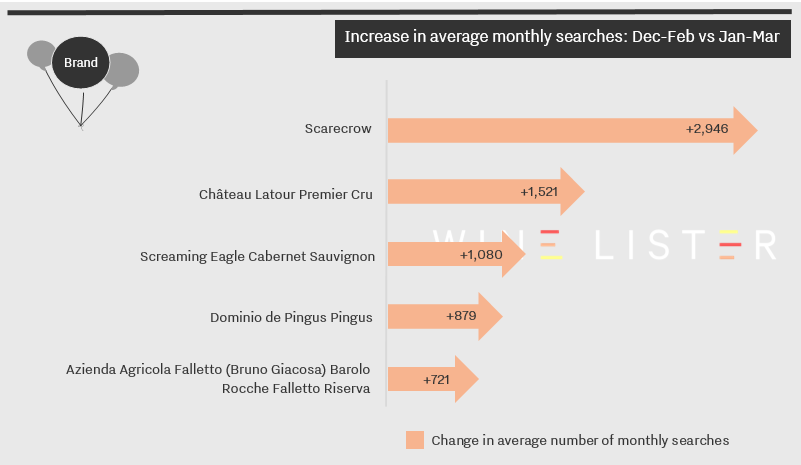
With the latest data now in from Wine Searcher, we took a look at which wines have seen their average monthly searches soar in the last month. The US boasts two wines in this top 5, with searches continuing to increase for Screaming Eagle, and Scarecrow seeing a significant uptick. Bottled relatively recently, Scarecrow 2014 scored 96+ from our US partner critic Antonio Galloni, who described it as “a wine of finesse.” At the end of February, Scarecrow 2014 was the top lot in a Premiere Napa Valley auction, selling for $200,000. The increase in searches has boosted Scarecrow’s Brand score from 868 to 885.

Wine Lister_increases in wine searches_April

Latour was the only wine from France to see its popularity rise last month, with searches for the Bordeaux first growth no doubt increasing as a result of the ex-château release in mid-March of Latour 2005, for €670 per bottle ex-négociant. Latour has the highest Brand score of all the wines in the table, with a near-perfect 999.

The final two wines to have seen a rise in popularity are Spain’s Pingus, whose 2014 recently received a 100-point score in the Wine Advocate, and Italy’s Azienda Agricola Falletto (Bruno Giacosa) Barolo Rocche Falletto Riserva. In March, Antonio Galloni praised “the genius of Bruno Giacosa” in a vertical tasting, and the increase in searches resulted in the wine’s Brand score rising from 812 to 822.

How is the popularity score calculated and how does it fit into the overall Wine Lister score?

Bordeaux 2016 en primeur part II: pricing, volumes, and timing

Our recent blog post reported the excellent quality of the Bordeaux 2016 vintage in the face of a tricky growing season, and discussed the generous yields that many producers enjoyed. In theory, the latter should keep en primeur release prices down. We took the temperature during our week in Bordeaux.

Olivier Bernard, President of the Union des Grands Crus de Bordeaux, declared that quantity is “good for the producers and for the people selling our wine, because it will help the château owners find the right price.” He went on to refer to the ease with which “mistakes” are made when quantity is low, a nod to over-zealous en primeur pricing in the past.

In a recent survey of Wine Lister’s 49 Founding Members (key global wine trade players), the average price adjustment for Bordeaux 2016 considered reasonable on 2015 was a decrease of 4%. Even the Bordeaux trade only suggest a 2% increase. It should be noted that this questionnaire was carried out prior to any tastings, and also that the trade’s interest naturally lies in curbing price rises by the producers.

price expectations v3

“What’s for sure is that prices to the consumer need to be significantly lower than current prices of physically available vintages such as 2005, 2009 and 2010,” asserted Stephen Browett, Chairman of Farr Vintners. “Why not allow all our distributors and consumers to make good buys and profitable sales of this vintage, with prices that are relatively stable compared to 2015?,” appealed Nicolas Ballarin, courtier at Blanchy et de Lestapis.

Wine Lister’s Founder, Ella Lister, is more sceptical, saying:

“I would be very surprised if Bordeaux 2016 prices do not increase on 2015, in some cases significantly. Every producer we spoke to said they would be upping prices on last year.”

“Price-wise I don’t think there is anyone who’s thinking about selling 2016 at a lower price than 2015,” confirmed Philippe Blanc, Managing Director of Château Beychevelle, hitting the nail on the head when he added, “the big question is how much more.”

This remains to be seen: the mood is broadly bullish but with a dose of caution. François-Xavier Borie, owner of Grand-Puy-Lacoste, summarised, “demand is good, and perception of the vintage is great,” concluding, “we will without doubt raise the price, but it shouldn’t explode.” His only fear is that things might be confused if certain châteaux adopt a different policy, going for “a high price on low volume.” Nicolas Glumineau, Managing Director of Pichon Longueville Comtesse de Lalande, agrees that partial releases at inflated prices are counterproductive, calling the approach artificial”, and saying it “doesn’t work to sell only 50% at a higher price.” Pichon Comtesse usually sells 80% of production en primeur.

“It’s a great vintage so it will be expensive,” confirmed Glumineau, disclosing, “my ambition is to raise the price this year, yes.” He is acutely aware, as are his fellow Bordelais, of mitigating factors such as the impending French elections. A Marine Le Pen victory “would affect the stock markets”, he says, and “could devalue the euro relative to the pound.”

Referring to the weak pound post-Brexit, Didier Cuvelier, owner of Léoville Poyferré, admitted, “it’s true England worries us as it’s always what sets the tone of the campaign.” Emmanuel Cruse, Co-owner of Château d’Issan and Grand Maître of the Commanderie du Bontemps, Médoc, Graves, Sauternes and Barsac, cited political uncertainty in the UK, the US, and France, when he announced to a room full of producers and négociants, “we all know the situation isn’t stable, but we need to be positive as the vintage is great and we have made a lot of it.” Mathieu Chadronnier, Managing Director of négociant CVBG, observed, “I really feel a desire here in Bordeaux for this to be a successful campaign.”
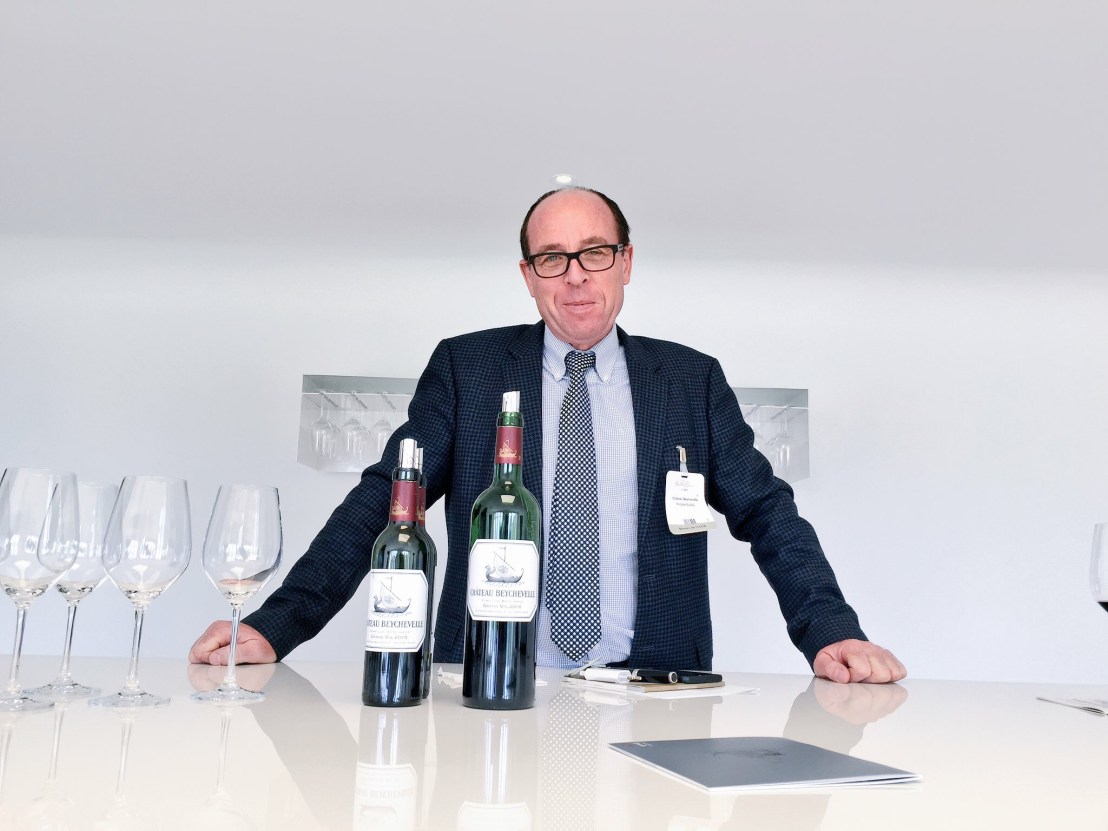
IMG_3237

Philippe Blanc, Managing Director of Château Beychevelle, who will almost certainly raise the price on 2015, but won’t be first out of the block. Photo © Ella Lister.

How will this positive approach affect timing for Bordeaux 2016? A couple of sources hinted at the possibility of a handful of early releases at the same price as last year, either by châteaux who priced highly last year or perhaps first growths wanting to set a trend. However, by far the dominant view was that the campaign would be a long one, lasting until after Vinexpo (18th-21st June in Bordeaux).

“A good campaign is one where timing follows a pattern – crus bourgeois first, then the fifth growths, the fourths etc.,” expounds Glumineau. Blanc believes, “the general opinion is not to be quicker than need be,” saying “it’s good to have context,” and confirming that Beychevelle “definitely won’t be the leader timing-wise.” Lister concludes:

“We await the first releases with interest, because of course nobody can predict the campaign’s level of success until the party actually gets started.”

Check www.wine-lister.com in early May for our new Bordeaux study, and follow us on Twitter for real-time analysis of the releases.


Piedmont dominates new Value Picks

The latest price data is in, enabling Wine Lister’s algorithm to award new Value Pick status to those wines that achieve the best quality to price ratio (with a proprietary weighting giving more importance to quality, thus allowing the finest wines a look-in).

Wine Lister Value Picks April 2017

This month, the new Value Picks include a Champagne, a Port, and a sweet white Bordeaux, but it is Piedmont that dominates, with three of its wines achieving Value Pick status: Poderi Luigi Einaudi Barolo Costa Grimaldi 2008, Luigi Pira Barolo Marenca 2007 and Giacomo Conterno Barbera d’Alba Cascina Francia 2010.

Each wine is priced at £44 per bottle or less – with half under £30 – and all have impressive Quality scores (based on ratings from our three partner critics) of 845 or above.

Prices per bottle are provided by our price partner, Wine Owners, whose own proprietary algorithms process millions of rows of incoming price data from Wine-Searcher to calculate a more realistic market level price – the price at which a wine is likely to find a ready buyer – based on market supply and spread models. As lower retail prices are likely to sell first, the prices you see on Wine Lister may be below the Wine-Searcher average in some instances.

Bordeaux 2016 en primeur part I: the vintage

The Wine Lister team is back from a week in Bordeaux tasting the 2016 vintage, and we can’t curb our enthusiasm. While the growing season was fraught with difficulty, a series of mini miracles allowed appellations across the board to make their finest wines since 2010. Most crucially, heavy spring rainfall was punctuated by a dry window during flowering, and intense summer drought was broken just in time by a dramatic rainstorm on 13th September, witnessed first-hand by Wine Lister’s Founder, Ella Lister, at Château Smith Haut Lafitte.

FullSizeRender

A sculpture at Château Smith Haut Lafitte as the storm brewed on 13th September 2016. Photo © Ella Lister

This vintage of extreme conditions has paradoxically resulted in the most balanced of wines, full of freshness. These are wines which, like the 1982 vintage in Bordeaux, will be approachable relatively early – possibly sooner than the 2010s – and will keep on going. Cheval Blanc’s Chef de Culture, Nicolas Corporandy, said that compared to the 2015, “the 2016 is fresher and more tannic”, adding, “they are very different vintages, a bit like the 2009 and 2010.”

However, apart from the odd reference to the 2009-2010 duo, 2016 was not likened to any existing vintage. Olivier Bernard, owner of Domaine de Chevalier and President of the Union des Grands Crus de Bordeaux, declared, “This is another expression – not a 2009 or 2010; we are working at a different level than a few years ago.” Many producers are touting 2016 as their best ever wine, and for once, they might not be exaggerating. “I really think honestly that it’s the most accomplished of all Pontet-Canets,” avowed Alfred Tesseron, owner of Château Pontet-Canet.

We were consistently impressed and delighted by the quality and harmony of the wines on left bank and right. In Lister’s words:

“Saint-Estèphe is driven, Pauillac poised, Pomerol blue-blooded, Saint-Emilion alluring, Saint-Julien classy, Margaux pure, and Pessac-Léognan seductive”.

Many wines exceeded our expectations, and we were especially delighted to return to Smith Haut Lafitte to taste the flawless range of wines and find them entirely unscathed by September’s hail.

IMG_3265

The excellent range of red and white wines tasted by the Wine Lister team at Château Smith Haut Lafitte in Pessac-Léognan. Photo © Wine Lister Limited

The even better news is that in general yields are higher than average (though with several exceptions, such as Châteaux Palmer, l’Evangile, and Léoville Poyferré). “With quality we have quantity and I love quantity,” quipped Bernard.

Why do yields matter? In theory, it should allow the producers to maintain reasonable prices if they have more wine to sell. As Nicolas Audebert, General Manager of Châteaux Canon and Rauzan-Ségla, put it, “Anyone who is intelligent will make their margins on the volume not on the prices; if the prices stay more or less the same when the quality is even better, everyone will be content”.

This could be wishful thinking. In the second instalment of this en primeur round-up we will explore the dynamics of the upcoming campaign, complete with the inside track from top producers and members of the trade regarding timing, pricing, and volumes, coming soon.

Check www.wine-lister.com for our partner critics’ scores over the coming weeks, and a new Bordeaux study, due for release here in early May.

Tuscany: a global contender

Wine Lister has produced its second in-depth regional study, this time on Tuscany – a many-faceted fine wine region that is fast-building its position on the global fine wine stage. We will be revealing some of the findings on the blog in the next few weeks, but the full 35-page report is available for subscribers on the Analysis page.

The study focuses on 50 top Tuscan wines, which we have compared below with 50 wines from Piedmont, Bordeaux, Burgundy, and California. Using the three categories that comprise an overall Wine Lister score – Quality, Brand, and Economics – we can put the region’s global positioning in context.

Tuscany Wine Lister Report - regional scores

Although Tuscany comes fourth overall – just ahead of Piedmont – its Quality score is bettered only by Burgundy, scoring 883 points to Burgundy’s 917. Quality scores are derived from Wine Lister’s partner critics’ scores and a wine’s ageing potential, and Tuscany’s excellence in this category may be one explanation for its rising appeal.

Tuscany’s Brand score is the fourth best of the group, suggesting that after a handful of top brands such as the Super Tuscans, the rest of the top 50 do not confer the same level of prestige as wines in Bordeaux, Burgundy, or even California. Meanwhile, the region’s commercial clout is the weakest of the group, scoring one point less than Piedmont in the Economics category.

In upcoming posts, we will delve into the trade’s view on Tuscany’s foremost appellations and which are the wines to watch.

Rising stars: trade backs Bordeaux

“Which producers will see the largest gain in brand recognition in the next two years?” That was one of the questions Wine Lister asked its Founding Members, in its latest survey of 49 of the world’s key wine trade players, between them representing well over one third of global fine wine revenues.

Of the producers expected to gain in brand recognition, the largest number were Burgundian (44 votes). Perhaps surprisingly – considering that the region already dominates the market – Bordeaux was only just behind (43 votes), suggesting that the trade still sees lots of room for brand growth in Bordeaux.

With Champagne in third place, France represents well over two-thirds of the strongest predicted gainers in brand recognition, while Italy followed with names from both Piedmont and Tuscany.

Rising Stars_Region Recognition

Bordeaux boasts four contenders in the top 10 producers cited. Canon garnered the most votes, and along with Figeac was already cited as a brand having risen significantly in demand. Canon’s Margaux sister, Rauzan-Ségla, also features here, as does the trade’s darling, Grand-Puy-Lacoste.

Burgundy features with three producers, showing that demand for the region’s top wines shows no signs of abating, while the Rhône and Champagne also make an appearance.

Rising Stars_Brand Recognition

Latour 2005 and Les Forts de Latour 2011 released

This morning sees the ex-château release of Latour 2005, along with second wine, Les Forts de Latour 2011. We have put together two factsheets bringing together all the most important information about these two formidable wines, both approaching their drinking windows.

The 2005 Grand Vin has the third-highest Wine Lister Quality score of the last three decades, and looks reasonable value next to the 2009 and 2010:

Latour 2005 thumbnail

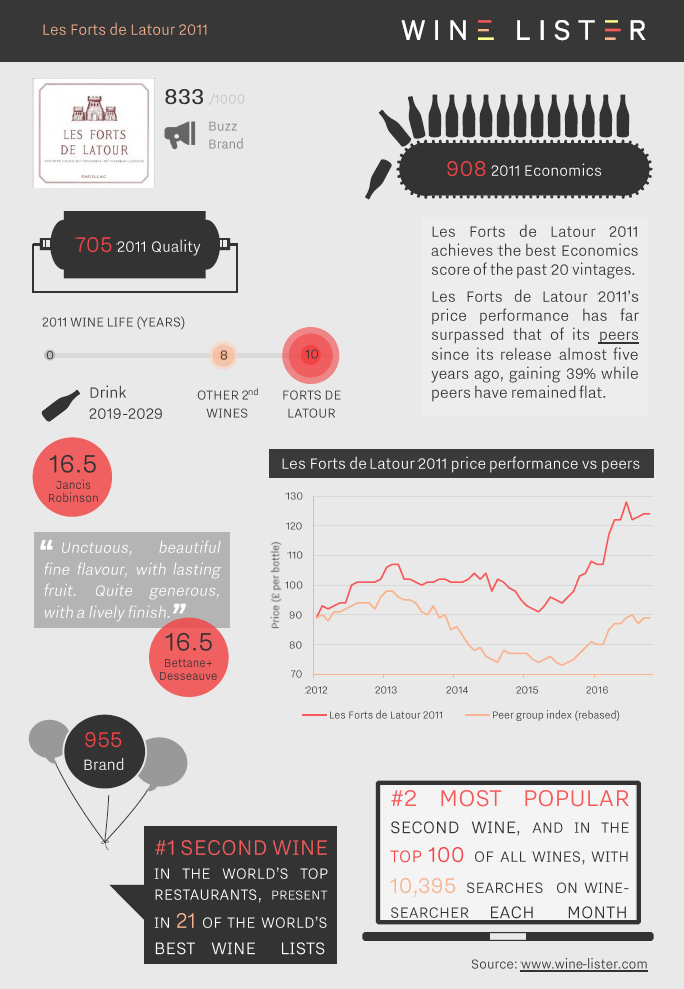
The 2011 vintage of Château Latour’s second wine, Les Forts de Latour, is an economic powerhouse, with impressive price growth since its release:

Forts de Latour 2011 thumbnail

You can download the slides here: Wine Lister Factsheet Latour 2005 / Wine Lister Factsheet Les Forts de Latour 2011

Online searches soar for major wine regions

Measuring the number of searches on the world’s most visited wine site, Wine-Searcher, provides a unique insight into an individual wine’s overall popularity. Following on from last week’s blog on wine searches we have aggregated two years’ worth of this data at region level, to put popularity in perspective and map fine wine market trends over time.

Wine Search Frequency

Above, we have taken the 50 most searched-for wines from the leading fine wine regions in France and Italy and tracked their changes in search frequency over two years. Despite natural peaks and troughs – including large spikes for Champagne during the festive season – the last six months show an acceleration in searches for wines of every region.

Several wine regions have seen searches more than double in the last two years, with Tuscany, Piedmont and Burgundy as the stand-out performers. Meanwhile, Bordeaux – the most searched-for region in real terms – has struggled to engage new audiences at the same rate as its counterparts. For more on Tuscany’s rising global clout, see our in-depth regional study, available to subscribers on the Analysis page.

To view the popularity of individual wines, simply search for your wine of choice on Wine Lister and explore the Brand score sub-criteria.

Value Picks

Wouldn’t it be brilliant if there was a tool to help you work out which wines represent the best value for money?  Well look no further; our Value Pick indicator algorithm puts that knowledge at your fingertips.

Analysing the very latest price data and reviews from our partner critics, Wine Lister’s algorithm awards Value Pick status to those wines that achieve the best quality to price ratio (with a proprietary weighting giving more importance to quality, thus allowing the finest wines a look-in).  Crucially, Value Picks are awarded at vintage not wine level.

Here are Wine Lister’s newest Value Picks:

value-picks-22_02_17

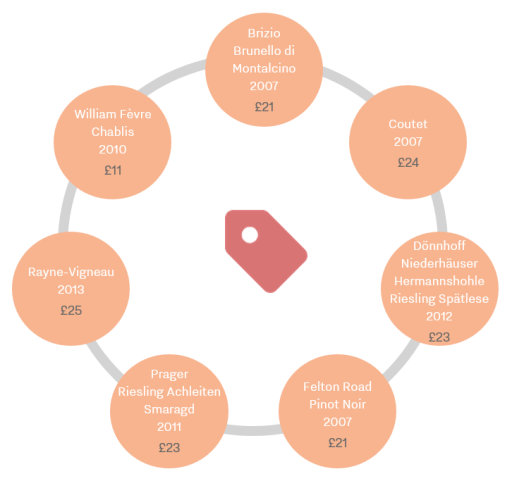
Wine Lister’s prices per bottle are provided by our price partner, Wine Owners, whose own proprietary algorithms process millions of rows of incoming price data from Wine-Searcher to calculate a more realistic Market Level price – the price at which a wine is likely to find a ready buyer – based on market supply and spread models.  Wine Owners believe lower retail prices will sell first, hence their price may be below the Wine-Searcher average in some instances.  As you can see, using this method, each of the new Value Picks is priced at £25 or under, with the cheapest costing just £11 (excluding tax).

Furthermore, other than William Fèvre Chablis (64/100), all of these wines have an average critic score of 74-77/100 on Wine Lister’s rebased, calibrated scale (where any score above the average of 40-60/100 is strong).  Underlining their appellations’ reputation for excellent value, two sweet white Bordeaux feature in the list: Coutet Premier Cru 2007, from Barsac, and Rayne-Vigneau Premier Cru 2013, from Sauternes.  Each earning an average critic score of 77 and with plenty of life still in them, these represent remarkable value for money.

Latour 2007 ex-château release

Today saw by far the largest release of Latour direct from the cellars since the property withdrew from the en primeur system starting with the 2012 vintage. Château Latour has released c.3,000 cases of its 2007, the first real test of its new distribution strategy, and reports from the Place are positive. Courtiers and négociants say the price has worked (for the first time the ex-château stock is released at market level, with no “provenance premium”), and report that the entire parcel has been sold, with demand “very strong”.

Using Wine Lister’s unique combination of data, we’ve created a visual guide to this exceptional château and its 2007 vinatge:

latour-thumbnail

You can download the slide here: latour-2007-slide